
19 November 2026
How Flag-it Automates FTA Decision No. 13 of 2026
Since 1 October, the VAT you claim back on purchases depends on more than a valid tax invoice. Under FTA Decision No. 13 of 2026, it also depends on what you checked about the supplier who sent it.
For most finance teams, that is a real change. The Decision builds on Article 54 bis of the VAT Law, added by Federal Decree-Law No. 16 of 2025. That article lets the FTA deny input tax where a purchase was tied to tax evasion and the buyer knew, or should reasonably have known. Decision No. 13 spells out what "should have known" means in practice.
There is no new penalty in it. What is at stake is the input tax itself, and it is recovered from you, not from the supplier who caused the problem. On a large purchase base, that can be far more than any fine.
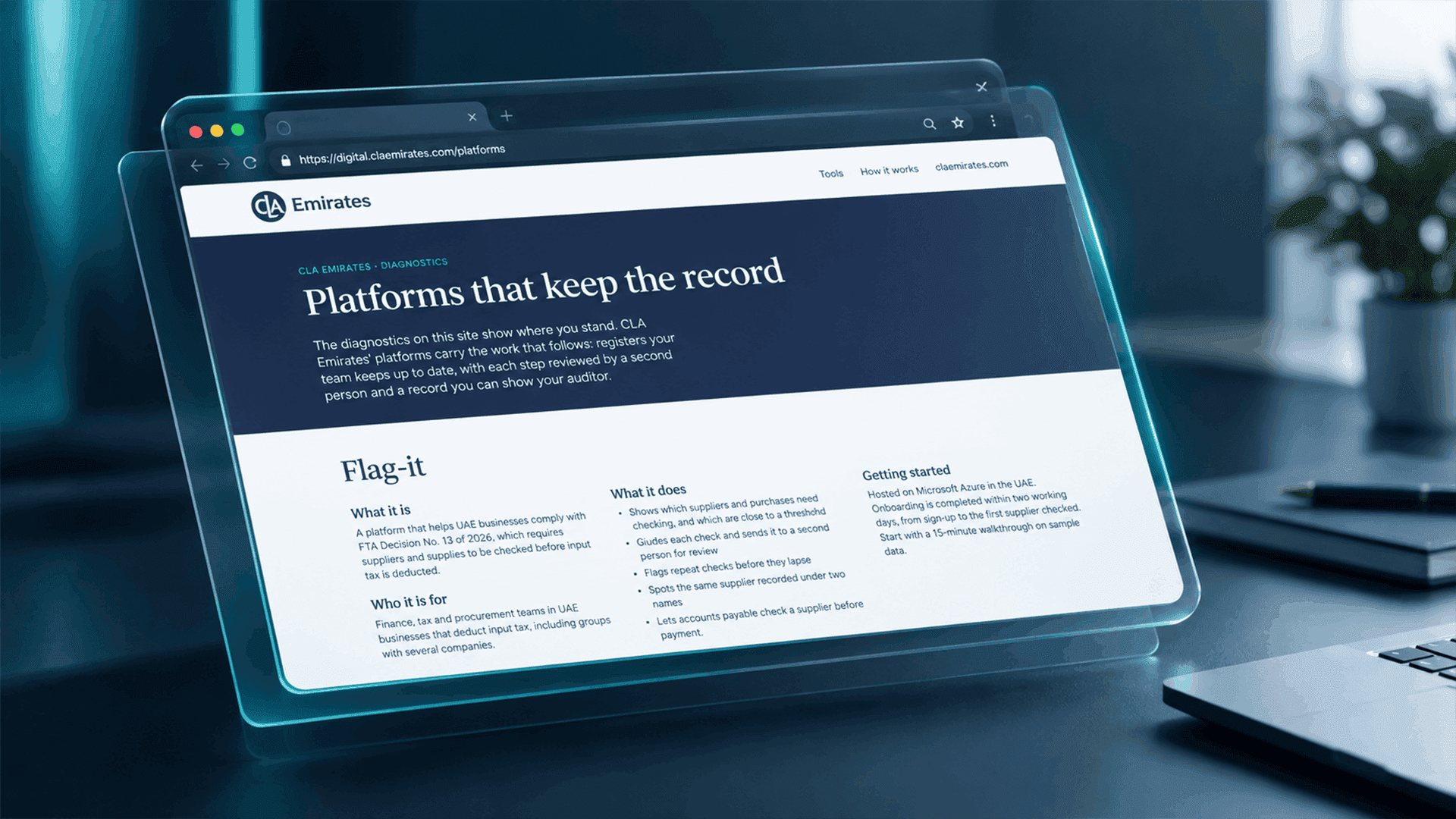
Flag-it, our SaaS platform, was built for exactly this. It reads your purchase ledger and supplier list, works out which thresholds apply to each supplier, and keeps a record of everything the FTA may ask to see.
| Not sure which of your suppliers are in scope? |
|---|
| Run the free scoping check. It reads your ledger in your browser and shows who is in scope, at which level, and how many verification files that means. Nothing is uploaded, and it costs nothing. |
The hard part is keeping track
The checks themselves are not complicated. You confirm who the supplier is and that they have a real place of business, and you look out for a few red flags. For the bigger suppliers, you also get a bank letter and look at their public reputation. Each supply then needs a quick sense check on price, payment and whether it makes sense for that supplier to be selling it.
What is hard is knowing which suppliers need what, and when. There is no year end here. You check a supplier when you first deal with them, and again if 12 months go by without a check. So every supplier runs on its own clock.
The thresholds make it trickier. Take two examples:
Supplier A sends you 40 invoices of AED 3,000 each. None of them is over AED 10,000, so it is easy to assume they are exempt. But together they come to AED 120,000. That is over the AED 100,000 limit, so the exemption falls away (Article 6(2)).
Supplier B sends one invoice for AED 12,000. The annual spend is small, but that single supply is over AED 10,000, so it was never exempt in the first place (Article 6(1)).
You cannot spot either of these from a single invoice. And once a supplier passes AED 375,000 in 12 months, two more checks come in (Article 3(4)). Try tracking all of that across a few hundred suppliers in a spreadsheet, and something will slip.
Where Flag-it comes in
Flag-it is a SaaS platform that takes this tracking off your team's plate. You upload your purchase ledger and supplier list, and Flag-it checks every supplier against every threshold. It keeps the record of every check, and it holds your verification policy, so everyone knows who does what. Your people still make the judgement calls. Flag-it does the counting and keeps the evidence.
In practice, that means:
- With every upload, each supplier is checked against the AED 10,000, AED 100,000 and AED 375,000 thresholds, and you can see which article put them in scope.
- Re-verification dates are tracked for each supplier and flagged before they run out. If nothing is due, the screen shows a zero. You are never left wondering whether a blank screen means "all clear" or "something went wrong".
- Your Article 5(4) policy lives in Flag-it. It names who performs, reviews and supervises each check. Whoever performs a check cannot also review it, and the system enforces that, so it does not depend on people remembering a rule.
- If two suppliers look like duplicates, Flag-it asks a person to decide. It will not merge them by itself, and it will not quietly skip one.
- Every decision is saved as a new version along with the figures behind it. If the FTA asks in three years why a supplier was treated a certain way, you can show them. The export lists the relevant article on every line.
Flag-it does not keep your ledger, only the calculations and a fingerprint of the file you uploaded. There is no AI guesswork either. Every figure is plain arithmetic on your own data.
| See Flag-it working on your own suppliers |
|---|
| Email [email protected] to book a demo of the platform. |
If you are reading this alongside the Decision itself, this is roughly how it lines up:
| What the Decision asks | Article | What Flag-it does |
|---|---|---|
| Know which suppliers are in scope, and at what level | 6, 3(4) | Works out each supplier's position on every monthly upload and shows the article behind it |
| Check a supplier on first dealing and every 12 months | 3, 5(1) | Tracks each supplier's own due date and flags it early |
| Identity, premises, red flags, bank letter, reputation | 3 | Lists the checks each supplier needs and what is still outstanding |
| Look at every supply you receive | 4 | Records each supply check with who did it and who reviewed it |
| Keep a record the FTA can follow | 5(3) | Saves every decision as a version and exports it with the article on each line |
| Have a policy that says who does what | 5(4) | Holds your policy, assigns roles and keeps the doer and the reviewer separate |
Getting started with Flag-it
Getting up and running is straightforward:
- Run the free scoping check. It reads your ledger in your browser and shows who is in scope, at which level, and how many verification files that means. Nothing is uploaded.
- Upload your purchase ledger and supplier list. Flag-it checks every supplier against the thresholds and shows you what each one needs. Your purchase listing only needs four columns.
- Set up your policy in Flag-it. Name the people who will perform, review and supervise the checks.
- Upload your purchase ledger each month. Flag-it updates every supplier's position, raises the checks that are due and adds to your record.
If you want a hand along the way, our tax team can help you write the policy, verify your existing supplier base, or carry out the checks you would rather not do yourselves.
Flag-it is built and maintained by our own team here in the UAE, specifically for this Decision. It runs on Microsoft Azure, and each client's data is kept separate at the database level. We update its rules as FTA guidance develops.
Frequently asked questions
What is FTA Decision No. 13 of 2026?
It sets out the checks a UAE VAT-registered business must carry out on its suppliers, and on each supply, to show it did not know and should not reasonably have known that a purchase was linked to tax evasion. It took effect on 1 October 2026.
What happens if we do not carry out the checks?
The Decision creates no penalties of its own. The risk is that the FTA refuses your input tax on the affected purchases under Article 54 bis of the VAT Law.
Which suppliers do we need to verify?
Supplies under AED 10,000 (excluding VAT) may be disregarded, unless that supplier's supplies exceed AED 100,000 over the previous or next 12 months. Above AED 375,000 in 12 months, a bank confirmation and a reputation review are added.
How often do we need to verify a supplier?
On your first dealing with them, and again on repeat dealings if no verification was done in the previous 12 months. Each supplier has its own 12-month clock.
What is Flag-it?
Flag-it is a SaaS platform from CLA Emirates. It checks your purchase ledger and supplier list against the Decision's thresholds, tracks each supplier's verification dates, holds your policy and keeps the record of every check.
Do we need a written policy?
Yes. Article 5(4) asks for a documented policy naming who implements, reviews and supervises the checks, with their powers and responsibilities. Flag-it holds this policy and enforces the roles in it.
Find out where you stand today
| Free scoping check: results in your browser, nothing uploaded |
|---|
| Run the free scoping check to see which of your suppliers are in scope and how many verification files you need. |
If you would rather talk it through, get in touch with one of us. We will tell you what the Decision means for your business and what it would take to get compliant.
- Ajil Varghese, Associate Director, Tax: +971 54 211 9621, [email protected]
- Akhil S Kumar, Manager, Indirect Tax: +971 54 211 9624, [email protected]
- Soumya Thekkumkara, Digital Transformation: +971 56 300 3750, [email protected]
This article is a general overview of FTA Decision No. 13 of 2026. It is not legal or tax advice, so please get professional advice for your own circumstances.
Author



Email Subscriptions
Right there with you, delivering insights and event invitations straight to your inbox.